
What Collier County requires
Every replacement garage door in Collier County must be rated for your home’s wind load, carry Florida Product Approval, and be installed under a building permit.
| Requirement | What it means in Naples |
|---|---|
| Design wind speed | 150 mph minimum for a typical home in Collier County; up to 170 mph in some areas (Collier CBO interpretation, Feb 2026) |
| Wind-load test | Doors are tested to ANSI/DASMA 108, ASTM E330 or TAS 202 (FBC Residential R609.4) |
| Windborne-debris region | Anywhere the design wind speed is 140 mph or more, which is all of Collier County |
| Glazed garage doors | Windows in the door need impact protection (ANSI/DASMA 115) in the debris region (FBC Residential R301.2.1.2) |
| Product approval | Florida Product Approval (FL number). Collier is not in the High-Velocity Hurricane Zone, so a Miami-Dade NOA is accepted but not required |
| Permit | Required for replacement. Collier, the City of Naples, Marco Island, Bonita Springs and Estero each issue their own. See our permit guide |
Code update: the Florida Building Code 9th Edition takes effect December 31, 2026. Permits applied for after that date are reviewed under the new edition.
Wind-rated vs. impact-rated: what’s the difference?
Wind-rated (also called wind-load or pressure-rated) means the door has been tested to resist a specified pressure pushing in and pulling out. That is its design pressure, written like +35.0 / -38.5 psf. Impact-rated means it has also passed a large-missile test, a 9-lb 2×4 fired at the door, and still held pressure afterward.
All doors we install are wind-rated for your opening. Impact rating is required for doors with glass, and it’s what earns the top insurance credit (below). For most Naples homes we recommend impact-rated.
Design pressure, in plain numbers
Design pressure is the load per square foot the door must withstand. It depends on the wind speed, the door’s size, your home’s exposure (open water and open land are tougher than a sheltered neighborhood) and how high the door sits. A 16×7-foot double door is 112 sq ft; at 40 psf that’s roughly 4,480 pounds of force on the door, which is why tracks, brackets and the wood frame around the opening matter as much as the door itself.
On permit applications in Collier County, the door’s design pressure must exceed the design pressure required for the opening. We calculate it and list it with the door’s FL number.
Insurance: the wind-mitigation credit
Florida insurers use the Uniform Mitigation Verification Inspection form (OIR-B1-1802). Your home’s opening-protection rating is set by its weakest opening. To earn the top credit, every opening: windows, doors and the garage door: must be impact-rated. If you’ve installed impact windows but kept an old garage door, the door may be costing you that discount. After installation we give you the product approval and permit documents your wind-mitigation inspector needs.
My Safe Florida Home grants
The state’s My Safe Florida Home program has offered matching grants ($2 for every $1 the homeowner spends, up to $10,000) for eligible homesteaded homes insured for $700,000 or less and originally permitted before January 1, 2008. A garage door qualifies only if the program’s free inspection recommends it. Funding opens and closes, so check availability before you plan around it.
Doors we install
- Insulated steel, impact-rated: the best value; carriage, flush and raised-panel styles
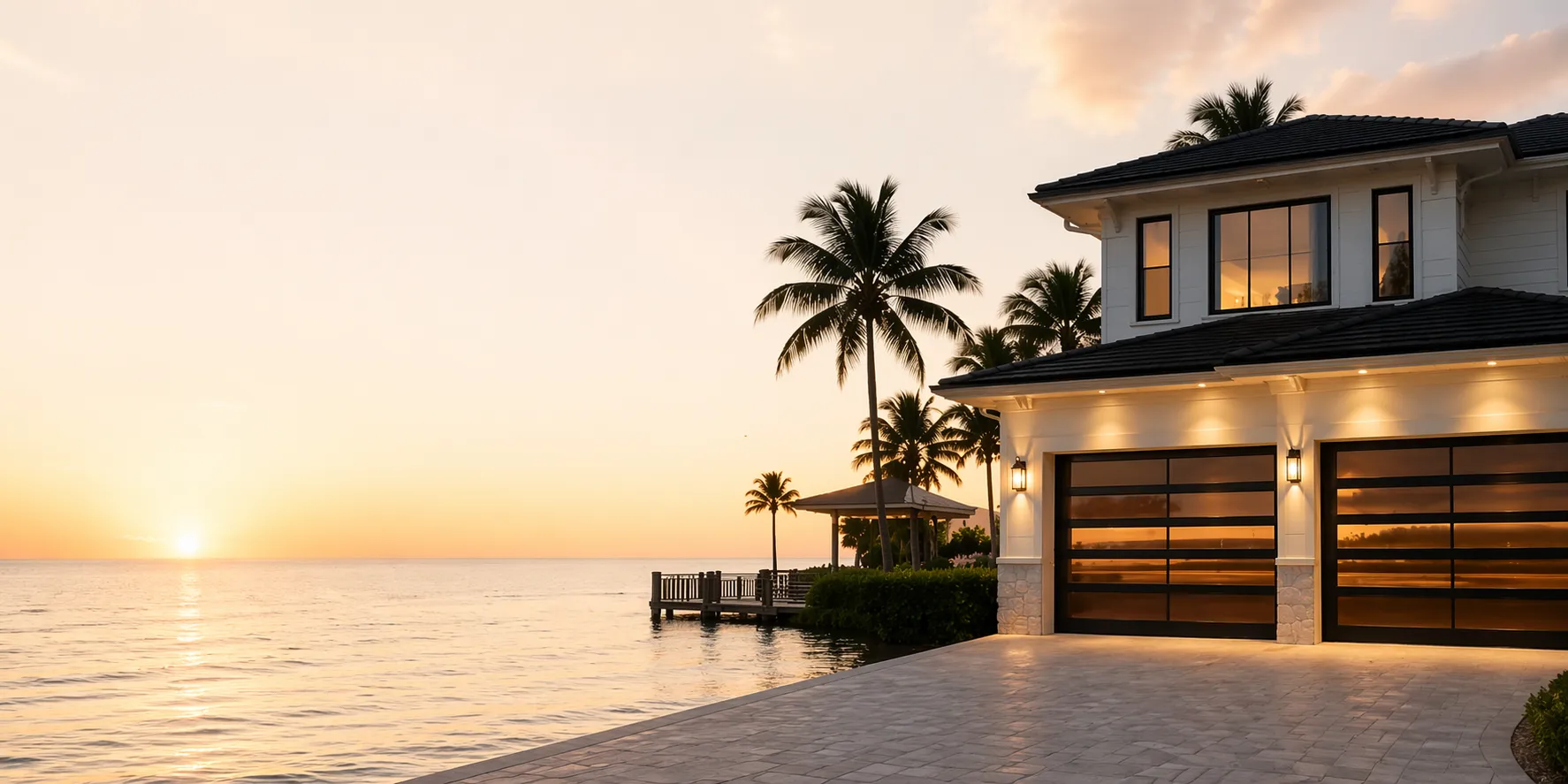
- Full-view aluminum with impact glass: the modern coastal look
- Wood-look and composite: warmth without salt-air upkeep
- From C.H.I. Overhead Doors, with Florida Product Approvals for residential doors up to 16 feet wide, including impact-rated options. Design yours.
Typical installed prices: $1,800 to $4,500 for a single-car door and $2,800 to $8,000 for a double, depending on size, glass and finish. Permit and haul-away are included. See the full cost guide.
Storm-day tips
- Keep the door closed. Don’t crack it open to “relieve pressure.”
- Older, unrated doors: ask about a retrofit brace kit as a stopgap until replacement.
- Before the season: have springs, cables and brackets checked. After Hurricane Ian, many failures were at the connections, not the door panels.
- Battery-backup opener: so you can open the door after the power goes out. See openers.
Code references are summarized for homeowners and are not a substitute for permit review. Requirements are confirmed for your address when we apply for the permit.